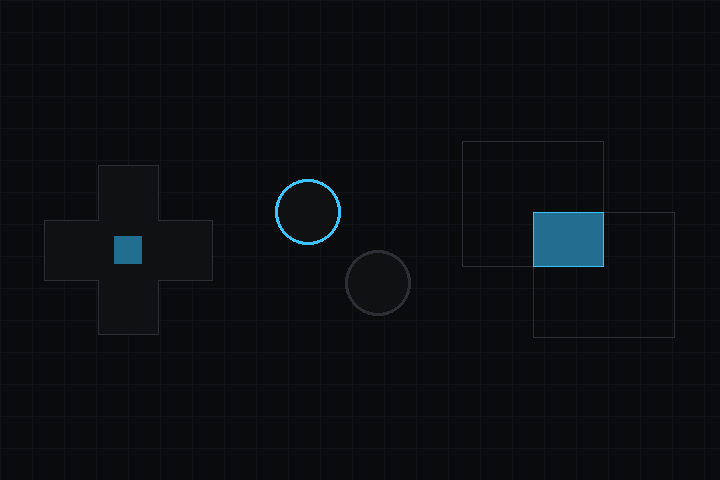
Input handling and collision detection
Repository: github.com/dekiengine/deki-input · Latest release: 0.19.0 · Needs engine 0.19.0+ · Requires: deki-rendering
Install with DekiEditor --packages-add deki-input <project>, or from the Package Manager. The engine's own components and C++ API are in the Deki docs.
Shown in the editor as Input.
Components
| Component | Category | Description |
|---|---|---|
| I2CKeyboardComponent | Input | Reads a keyboard that hands over one typed character per I2C read: the LilyGO T-Deck's, the M5Stack CardKB. |
| InputCollider | Input | Hit area for pointer and touch. Buttons and scrolls listen to it. |
| TrackballComponent | Input | A trackball on GPIO pins, as arrow keys and Enter or as a pointer. |
Feature flags
Parts you can leave out of a build. A feature with a define is switched there; the rest are stripped with their components.
| Feature | Define | Default |
|---|---|---|
| Colliders | DEKI_FEATURE_INPUT | on |
| I2C Keyboard | DEKI_FEATURE_INPUT_I2C_KEYBOARD | on |
| Trackball | DEKI_FEATURE_INPUT_TRACKBALL | on |
Component reference
I2CKeyboardComponent
Reads a keyboard that hands over one typed character per I2C read: the LilyGO T-Deck's, the M5Stack CardKB.
Inspector name: I2C Keyboard · Category: Input · Type: DekiInput::I2CKeyboardComponent
| Property | Type | Default | Constraints | Description |
|---|---|---|---|---|
| i2cPort | int32 | 0 | 0 to 3 | Which I2C bus the keyboard is on. Must match the I2C Bus component that set that port up. |
| i2cAddress | int32 | 85 | 0 to 127 | The keyboard's address on the bus: 0x55 (85) for the LilyGO T-Deck, 0x5F (95) for the M5Stack CardKB. |
| hasBacklight | bool | false | The keyboard has a backlight it controls itself, set over the bus (the LilyGO T-Deck's: brightness in register 0x01). Game code then sets it with I2CKeyboard::SetBacklight. |
InputCollider
Hit area for pointer and touch. Buttons and scrolls listen to it.
Inspector name: Input Collider · Category: Input · Type: DekiInput::InputCollider
| Property | Type | Default | Constraints | Description |
|---|---|---|---|---|
| width | float | 0 | in m | Width of the hit area in meters. It does not have to match what is drawn. |
| height | float | 0 | in m | Height of the hit area in meters. |
| paddingLeft | float | 0 | in m | Extra hit area beyond the left edge, in meters. Useful for making a small control comfortable to hit with a finger without making it look bigger. |
| paddingRight | float | 0 | in m | Extra hit area beyond the right edge, in meters. |
| paddingTop | float | 0 | in m | Extra hit area above the top edge, in meters. |
| paddingBottom | float | 0 | in m | Extra hit area below the bottom edge, in meters. |
| consumeInput | bool | true | Stop the press here instead of letting it reach objects underneath. Turn it off for an overlay that should not block what is behind it. |
TrackballComponent
A trackball on GPIO pins, as arrow keys and Enter or as a pointer.
Inspector name: Trackball · Category: Input · Type: DekiInput::TrackballComponent
| Property | Type | Default | Constraints | Description |
|---|---|---|---|---|
| mode | enum | "Keys" | Keys, Pointer | Keys: rolling presses the arrow keys and the click is Enter. Pointer: rolling moves a pointer and the click is a mouse button. |
| pixelsPerStep | int32 | 4 | 1 to 64 | Pointer mode: how many pixels one step of the ball moves the pointer |
| glideMs | float | 0 | 0 to 1000 | Pointer mode: how long the pointer keeps gliding after the ball stops, in milliseconds, like a ThinkPad TrackPoint. 0 moves it exactly by the steps rolled. |
| acceleration | float | 1 | 1 to 8 | Pointer mode with a glide: how many times further each step carries the pointer when the ball is spun fast than when it is rolled slowly. 1: no acceleration. |
| upPin | int32 | -1 | -1 to 48 | The line that pulses when the ball rolls up |
| downPin | int32 | -1 | -1 to 48 | The line that pulses when the ball rolls down |
| leftPin | int32 | -1 | -1 to 48 | The line that pulses when the ball rolls left |
| rightPin | int32 | -1 | -1 to 48 | The line that pulses when the ball rolls right |
| clickPin | int32 | -1 | -1 to 48 | The click switch (-1 = none) |
| clickActiveLow | bool | true | The click pulls its pin low when pressed (on), or high (off) |
Changelog
0.19.0
Changed
- minEngine 0.19.0: built against engine 0.19.0, whose component metadata records the package each class is in. A build of this package from before does not load and is rebuilt.
Added
- Japanese, Simplified Chinese and Korean: editor/lang/ja.json, zh.json and ko.json translate the names, tooltips and enum values this package's components show in the Inspector.
0.18.2
Added
- The keyboard's backlight: I2CKeyboard::SetBacklight(0-255), for a keyboard that sets it itself over the bus (hasBacklight on I2CKeyboardComponent; the LilyGO T-Deck's takes it in register 0x01).
- The trackball can move like a ThinkPad TrackPoint (pointer mode, glideMs and acceleration on TrackballComponent): rolling sets the pointer going and it glides on briefly after the ball stops, and spinning the ball fast carries it further per step. glideMs 0, the default, moves it exactly by the steps rolled, as before.
- InputEvent::source: the name the source that sent an event was registered under ("I2CKeyboard", "Trackball", "SDL3", ...), so a listener can tell a trackball's arrows from a keyboard's.
- RegisterEventCallback returns an id, and UnregisterEventCallback(id) removes the callback. A component that listens must stop before it is destroyed; there was no way to.
Earlier releases: CHANGELOG.md.
Generated from the package's reflection data (engine 0.19.0). Property names are the keys used in scene files. Renames keep an alias (compatibility).